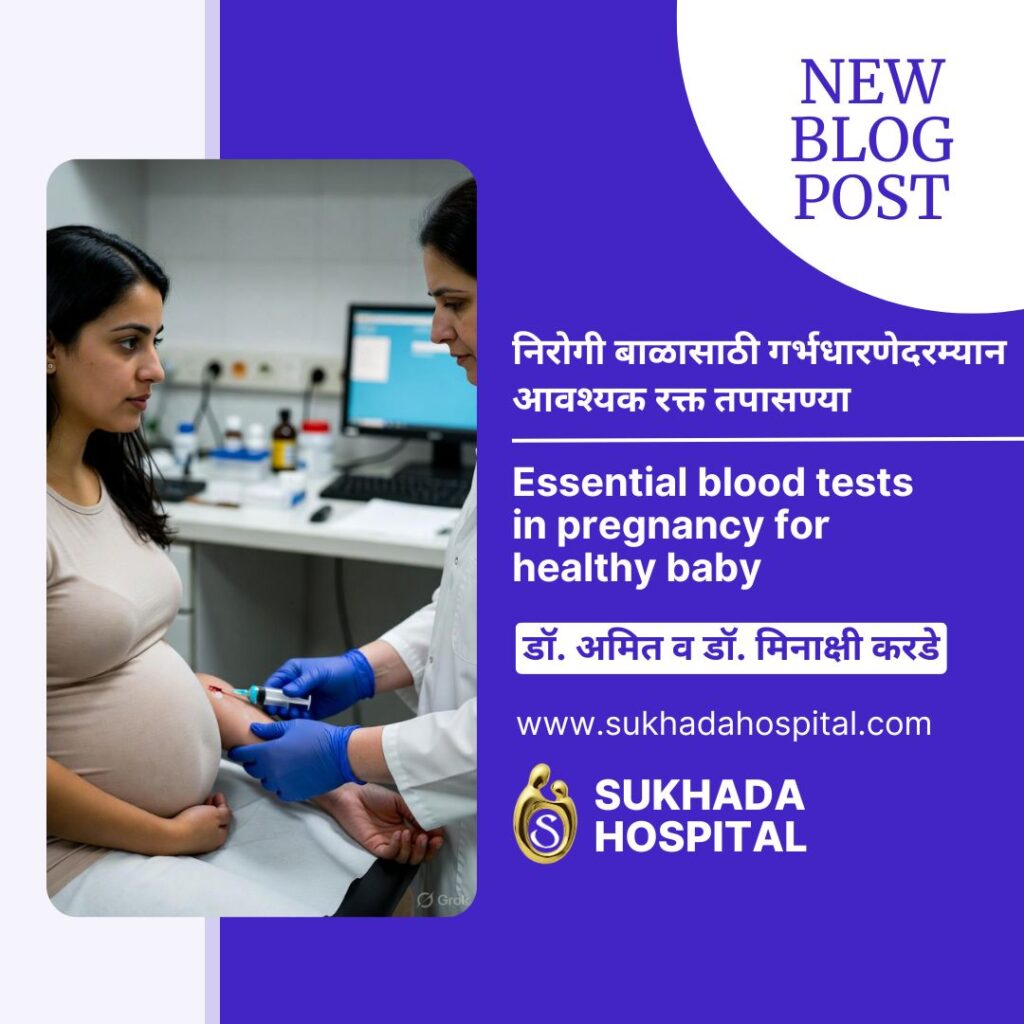
Pregnancy is a beautiful journey, but it also requires careful medical monitoring to ensure the health and safety of both mother and baby. One of the most important parts of prenatal care is routine blood tests during pregnancy. These tests help doctors detect potential health issues early, monitor the mother’s health, and ensure the baby is developing normally.
Blood tests during pregnancy can check for anemia, infections, blood group compatibility, thyroid disorders, diabetes, and nutritional deficiencies. Early detection allows timely treatment and helps prevent complications during pregnancy and delivery.
At Sukhada Hospital, Ahilyanagar, comprehensive antenatal care includes all essential blood tests and expert monitoring to ensure a safe and healthy pregnancy.
Pregnancy is a physiological process and to adjust to the fetus the body undergoes many changes. As you all know Pregnancy is divided into 3 trimesters
1st trimester: comprising of the first 12 weeks
2nd trimester: 13 – 28 weeks
And 3rd trimester: 29 to 40 weeks
There are two main types of confirmatory tests for pregnancy — urine tests and blood tests. Often, you’ll take a urine test (UPT) at home with a home pregnancy test kit. This type of test can be purchased over-the-counter (you don’t need a prescription from your healthcare provider).
Gold standard Blood test for pregnancy confirmation is Serum Beta HCG test. A quantitative human chorionic gonadotropin (HCG) test measures the specific level of HCG in the blood. HCG appears in the blood and urine of pregnant women as early as 10 days after conception. Quantitative HCG measurement helps determine the approximate age of the fetus. It can also assist in the diagnosis of abnormal pregnancies, such as ectopic pregnancies, molar pregnancies, and possible miscarriages.
- Hemogram (CBC)
- Blood sugar fasting and postprandial (Post Meal)
- Blood group
- VDRL (syphilis)
- TSH (thyroid)
- Hepatitis B antigen
- HIV
- Anti HCV
- Abnormal hemoglobin profile
- Urine routine with reflex urine culture
Hemogram: consists of RBC parameters like Hemoglobin, WBC parameters and platelet parameters. This test lets the doctor analyze your blood Iron level and to rule out any type of anemia.
Fasting and post prandial blood sugar is done to rule out diabetes.
TSH test is advised to rule out hypothyroidism/hyperthyroidism.
Both Diabetes as well as thyroid disorders need to be treated or controlled to avoid any complications in the pregnancy. These two parameters have to be monitored all through pregnancy.
Hepatitis B antigen, Anti HCV, VDRL are done to find and treat these infections so that mother to baby transmission can be avoided.
HIV antibodies too are done for the same cause so that the treatment can be given to reduce the chances of transmission from mother to baby.
Blood group is a crucial test. It determines whether the mother’s Rhesus (Rh) factor is compatible with that of the developing baby’s Rhesus factor. Red blood cells have a protein called the Rh factor on their surface that is inherited. You are Rh positive if the protein is present on your RBCs. You are Rh negative if the protein is missing from your RBCs. If a mother is Rh-negative and her fetus is Rh positive, this is known as Rh incompatibility, and the woman’s body may produce antibodies against the Rh factor. These antibodies may harm the RBCs of the fetus. Typically, a first pregnancy is unaffected by this since the body produces few antibodies at that time. It might, however, have negative effects on a subsequent pregnancy.
For Rh incompatibility, the majority of women will be given a shot of Rh-immune globulin at 28 weeks and again a few days after delivery
Abnormal Hemoglobin disorders– This test helps to rule out if the mother is a carrier for an abnormal hemoglobin gene e.g., Thalassemia. In case the mother is a carrier the father is tested for the same and further management is suggested depending on the result.
Urine routine: helps to rule out urine infection.
Other investigations that can be advised are the glucose challenge test, TORCH complex and Dual maternal marker studies.
In patients who have a family history of diabetes and the fasting and postprandial blood sugar levels are inconclusive, in those patients a glucose tolerance test is performed. In this test a fasting blood sample is taken and a measured glucose solution is given and blood samples are taken after certain period, the values are then analyzed.
TORCH test is a short form of Toxoplasma, Rubella, Cytomegalo virus and Herpes simplex virus 1 and 2. These infections are responsible for disruptions in fetal growth and development. Antibodies detected in this test can tell the doctor if the mother has an active or past infection or due to vaccination.
Dual Marker test:
Early in pregnancy, PAPP-A screening is performed, and aberrant levels are connected with an increased risk for chromosomal abnormalities. Early in pregnancy, the placenta produces the hormone known as human chorionic gonadotropin (hCG). Chromosome problems are linked to its aberrant amounts.
The likelihood for diagnosing genetic birth abnormalities such Down syndrome (trisomy 21) and trisomy 18 in a developing newborn is increased when both of these tests are used together.
Detection rate is about 85-92 %
In case these tests have not been performed in the first trimester they are asked to be done on your first visit to the doctor.
Second trimester is mostly follow-up of the above tests.
The tests routinely performed are Hemogram (CBC), TSH, Blood sugar levels (fasting and post prandial) and urine routine. Hba1c is done in diabetic women. Glucose tolerance test is done in high-risk women to detect gestational diabetes.
In pregnancy, there is water retention which causes dilution of blood. So hemogram test is required to monitor hemoglobin so that the further trimester and delivery are uneventful
Blood sugar level: poor glucose control in maternal blood can cause spontaneous abortions, preterm delivery, fetal malformations, disturbed fetal growth, unexplained fetal death. Hence sugar levels are checked again.
Triple and quadruple maternal markers are also done in the 2nd trimester. these marker tests are done to rule out chromosomal anomalies.
As the name says in triple marker test 3 hormones are measured. It is done between 23 – 26 weeks
Maternal alpha feto-protein (AFP), HCG and unconjugated estriol (Triple marker)
Detection rate is about 73%
Quadruple marker: 14 to 22 weeks.
Beta HCG, AFP, unconjugated estriol and inhibin A
Detection rate is 85-92%.
Both Dual and Quadruple test when done give a better chance at detecting the chromosomal anomalies
In case these tests are positive the doctor can guide you to non-invasive tests like NIPT (Non Invasive Pregnancy Test) and Karyotyping. These tests are performed on maternal blood. Some invasive tests can also be asked by the doctor as a last resort, like chorionic villi sampling. In this test a needle is passed into the uterus and a small sample of the placenta is collected to perform advanced chromosomal tests.
It has the least number of tests. Hemogram, Blood sugar and TSH.
A vaginorectal culture at 35 to 37 weeks of gestation can rule out GBS infection. (Group B streptococcus). To avoid passing of infection to baby during delivery.
There is no need to repeat every blood test. But you must do the blood tests recommended to you by your doctor.
What investigations are a must in the last trimester a few days before delivery?
Most common ones suggested are Hemogram, blood sugar levels.
In case you have a predisposing factors like family history, if you are overweight, or have had excess weight gain, or have history of gestational diabetes then it is advisable to screen blood sugar every month of the pregnancy.
The goal should be
Fasting blood sugar: <=95 mg/dl
post prandial: <= 120
HbA1C <= 6%
It is also advised by some practitioners to get your fasting and Post prandial blood sugar level checked every 2 weeks in the last trimester to help maintain proper glycemic control.
Thyroid disorders are more common in female as compared to males. Majority of these women do not have any symptoms in their routine life. But during pregnancy there is an added burden on your thyroid hormone. In situations like these there are chances that a woman can develop Hyper or hypo thyroidism any time during the entire course of the pregnancy. And during pregnancy the thyroid symptoms can be masked.
Both hyper and hypo thyroidism have adverse effects on the growing baby. It can cause problems in growth or may even lead to death or abortion of the baby.
These complications can be easily avoided by simple TSH screening. Hence it is done every trimester.
Regular blood tests play a vital role in monitoring maternal health and ensuring the baby’s well-being throughout pregnancy. These tests help detect conditions such as anemia, gestational diabetes, infections, thyroid disorders, and blood group incompatibility, allowing doctors to manage them early.
With proper prenatal care, timely testing, and expert medical supervision, most pregnancy complications can be prevented or managed effectively. Expecting mothers should always follow their doctor’s advice and complete all recommended tests during pregnancy.
For reliable pregnancy care and accurate diagnostic testing, Sukhada Hospital, Ahilyanagar provides comprehensive antenatal services to support mothers through every stage of pregnancy.
Contact
Dr. Karade’s
Sukhada Hospital
Contact us to book consultation for compassionate care in maternity, gynecological issues across all ages, infertility treatments, and advanced laparoscopy surgeries for women.
Book Appointment:
02412329966
Emergency number:
9422224158
Address:
Opposite Police Colony, Balikashram Rd, Bagade Mala, Ahilya Nagar, Maharashtra 414001.
Meet The Doctors

Dr Amit Karade
M.B.B.S., D.G.O.
Consultant Gynecologist & Laparoscopic Surgeon

Dr. Minakshi Karade
M.B.B.S., D.G.O.
Consultant Gynecologist & Fertility Expert
आई आणि बाळाच्या आरोग्यासाठी प्रत्येक क्षणी तुमच्यासोबत...

Our services
Sukhada Hospital offers compassionate and comprehensive care for women of all age groups, guiding them through every phase of life, from the joys of motherhood to the challenges of peri- and post-menopausal years.
Maternity Care:
Personalized care for a safe and joyous pregnancy, childbirth, and postnatal recovery.
Gynecology:
Expert solutions for women’s health concerns, from adolescence to menopause.
Laparoscopy:
Advanced minimally invasive procedures for precise diagnosis and treatment.
Infertility Treatments:
Evidence-based treatments to fulfill the dream of parenthood with care and support.